Blogs
Weekly Air Quality in Selected Towns of Sri Lanka (2 – 8 November 2026)
Summary for 2 – 8 November 2026:
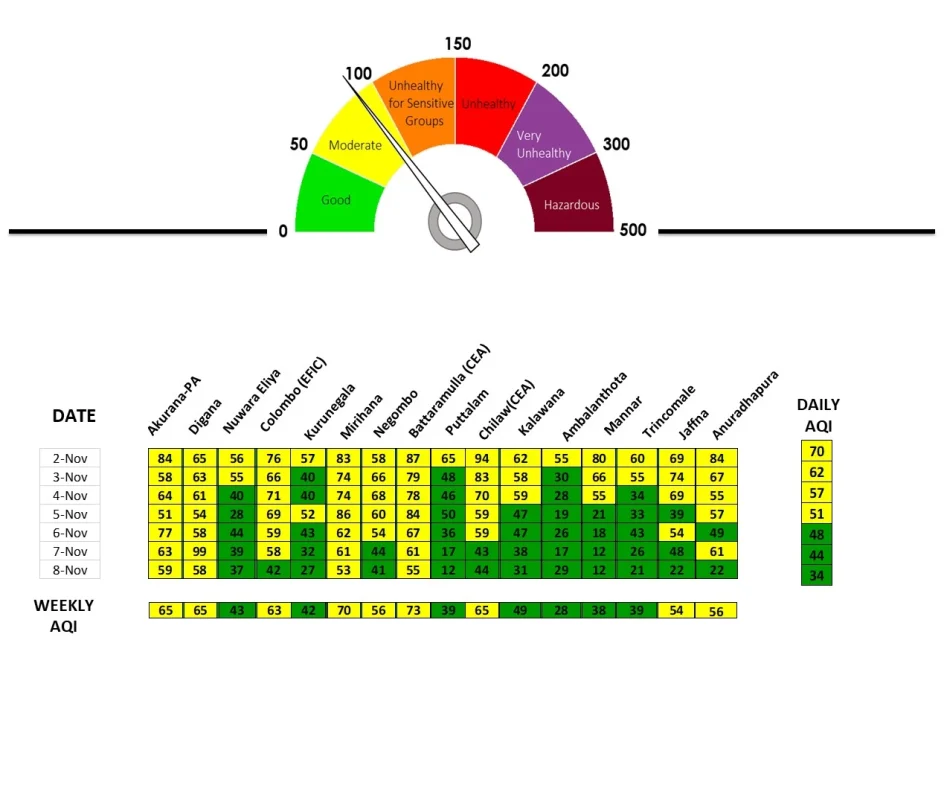
Overall, air quality improved significantly this week compared to the previous reporting period. From 02–08 November, daily air quality across Sri Lanka generally ranged from ‘Good’ to ‘Moderate’. At the beginning of the week, air masses entered Sri Lanka from the southwest. Later, the wind direction shifted, with winds beginning to flow from the northeast.
Weekly Air Quality Ranking:
The monitored locations with the highest weekly average AQI values were:
Chilaw recorded the highest daily average AQI of 94 on 02 November, falling within the ‘Moderate’ category.
Based on the weekly average AQI, Akurana, Digana, Colombo, Mirihana, Negombo, Battaramulla, Chilaw, Jaffna, and Anuradhapura recorded ‘Moderate’ air quality, while all other monitored locations recorded ‘Good’ air quality.
Weekly Air Quality Index (AQI) Levels:
- Moderate (AQI 51-100):Akurana, Digana, Colombo, Mirihana, Negombo, Battaramulla, Chilaw, Jaffna, Anuradhapura
- Good (AQI 0-50): Nuwara Eliya, Kurunegala, Puttalama, Kalawana, Ambalantota, Mannar, Trincomalee
Observed fine particulate measurements by the hour for the last week
![]()
![]()
![]()
AIR QUALITY BASICS
Air pollution, a widely- talked and argued topic today has been a primary cause of unforeseen climatic changes, many health problems associated with respiratory diseases and ecosystem damage. Vehicular and industrial emissions, dust, burning of fossil fuels, open burning of garbage waste and natural phenomena such as volcanoes, wildfires and pollen contribute to air pollution. Polluted air consists of both particulate matter of fine dimensions and gaseous matter. The presence of these impurities decreases the pureness of the air we breathe.
AQI
United States Environmental Protection Agency (US EPA) has set up a standard to measure the level of air pollution by the following 5 major air pollutants:
- Ground- level ozone (O3)
- Particle pollution (PM2.5 and PM10)
- Carbon monoxide (CO)
- Sulphur dioxide (SO2)
- Nitrogen dioxide (NO2)
Particulate matter of diameter less than 2.5 micrometers (PM2.5) and diameter less than 10 micrometers (PM10) and gases, ozone, carbon monoxide, sulphur dioxide and nitrogen dioxide have been identified as major air pollutants.
The AQI standard for ozone and particle pollution according to US EPA comprises of six categories. Each category is assigned a specific colour and corresponds to a different level of health concern. As the scale grows the air quality turns from good to extremely unhealthy.
Access to real- time air quality data from laser air quality sensoring instruments operated by FECT is available at www.cleanair.lk

